01 · COLLECTION
KNNN Collection
Explore objects shaped through Korean materials, traditional techniques, and contemporary design.
Korean Traditional Lacquerware · Najeonchilgi
Not simply decoration, but a surface built through light, lacquer, and time.
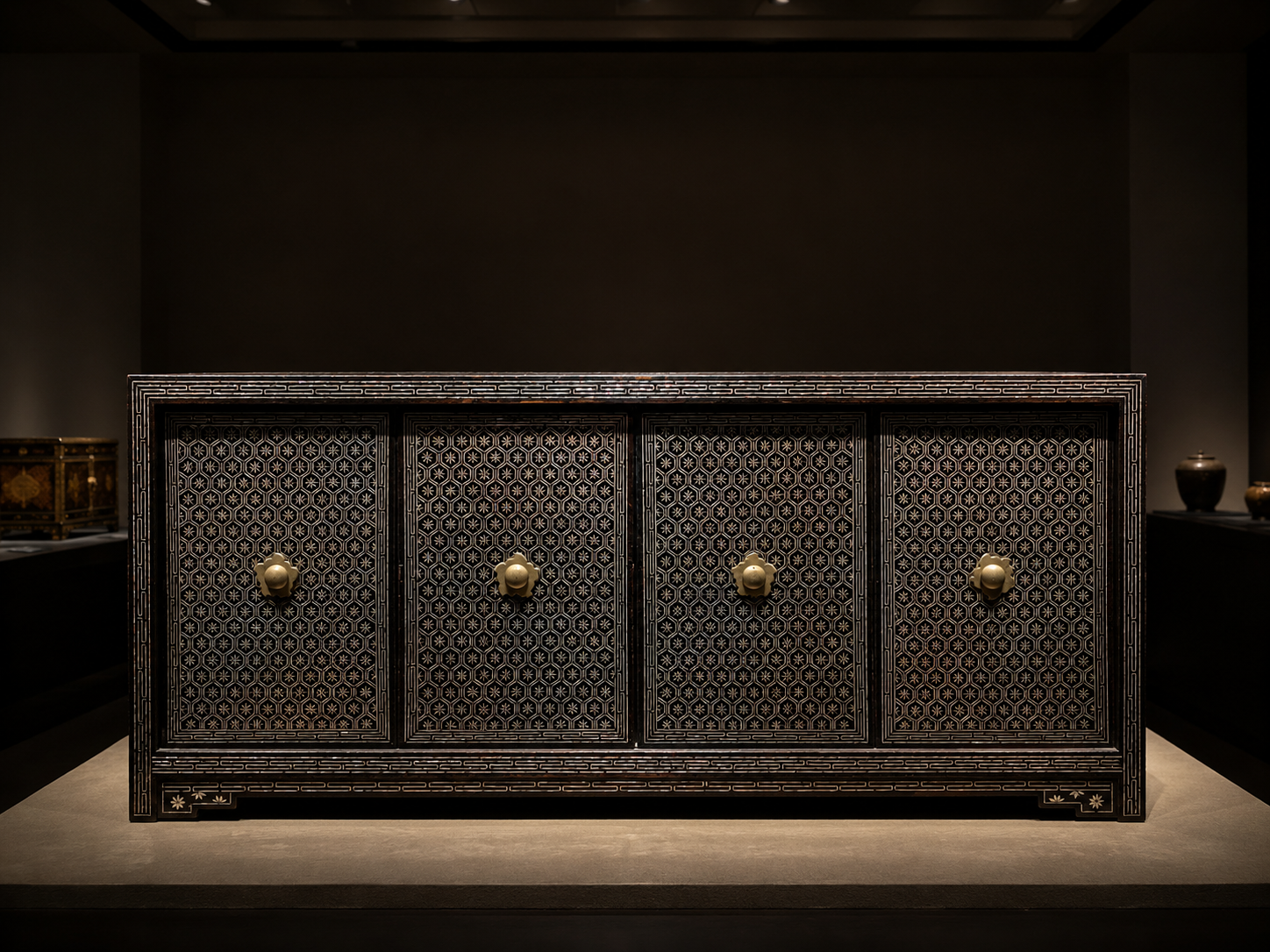
Najeonchilgi is Korea’s tradition of setting mother-of-pearl into lacquered surfaces. Its beauty comes from more than iridescence: it is the result of material knowledge, repeated handwork, and a process refined across centuries.
Najeonchilgi
Najeonchilgi (螺鈿漆器) brings together two materials with very different characters: mother-of-pearl that catches and shifts light, and lacquer that builds depth, protection, and a quiet ground beneath it.
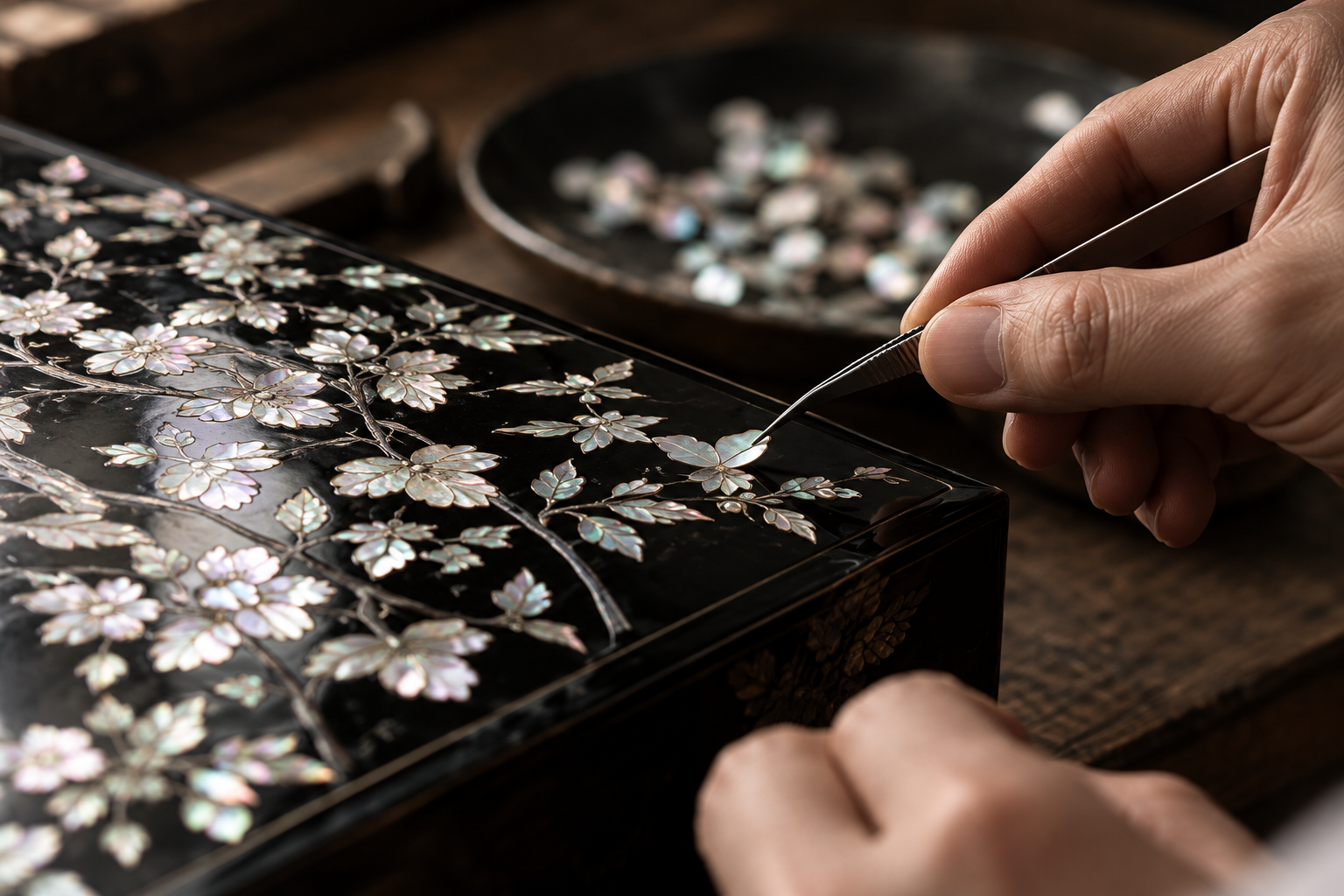
Thin pieces of shell are cut, shaped, and placed by hand onto a prepared surface. Lacquer is then applied, cured, refined, and polished through repeated stages until shell and lacquer become visually and physically integrated.
The finished surface never appears completely fixed. Blue, green, violet, silver, and warm tones can emerge or disappear as the viewer and the light move.
Decoration made with the iridescent inner layer of shell, commonly called mother-of-pearl.
Lacquerware built through repeated applications and finishing of natural lacquer.
Heritage
Korean lacquer has a long history. Mother-of-pearl inlay became especially significant during Goryeo and continued to change in composition, motif, scale, and use through Joseon and into the present.

Woodworking and lacquer traditions already existed on the Korean Peninsula, providing the material and technical foundation from which later lacquer arts developed. Long before mother-of-pearl inlay became fully established, artisans had already built knowledge around wooden forms, surface preparation, protective coating, and the slow curing processes required by natural lacquer.
This earlier foundation matters because Najeonchilgi did not appear suddenly as decoration alone. It grew from an existing culture of making in which lacquer was already valued as both a practical and refined surface.
During Goryeo, mother-of-pearl inlay became one of the most distinguished forms of Korean lacquerware. Surviving works are known for highly refined composition, minute shell elements, and sophisticated surface treatment, showing an exceptional level of technical control.
Because the process required costly materials, long hours of labor, and advanced skill, Goryeo Najeonchilgi is generally understood as an art of elite demand. Royal circles, aristocratic households, and Buddhist temples formed the main sphere in which such objects were commissioned, preserved, and valued.
In this sense, Goryeo Najeonchilgi was not simply decorative craft, but one of the highest expressions of luxury, devotion, and status in Korean material culture.
In the Joseon period, the visual language of Najeonchilgi continued to change. Compositions could open up, shell pieces could become larger, and motifs expanded to include floral scrolls, birds, landscapes, auspicious symbols, and geometric patterns.
Najeonchilgi remained a high-value object, but its social use gradually broadened. Beyond the royal court and yangban households, it came to appear more widely among wealthy merchants and economically established private households. This shift became especially visible in furniture and domestic objects such as chests, wardrobes, document boxes, and dressing tables.
By the late Joseon period and into the modern transition, Najeonchilgi can be understood less as an exclusively court-centered art and more as a refined form of luxury living craft, connected not only to prestige but also to household culture, gifting, and marriage furnishings.
Korean artisans continue to transmit traditional methods while also applying mother-of-pearl and lacquer to new scales, forms, and contemporary objects. The craft survives not only through preservation, but through adaptation.
Today, Najeonchilgi is understood at once as heritage, fine craftsmanship, and a living material language. It can appear in traditional works, collectible objects, modern furniture, design pieces, and contemporary reinterpretations that carry earlier techniques into present use.
Material
The character of Najeonchilgi is not created by painted color. It comes from the physical properties of shell, the depth of lacquer, and the time required to bring both into one surface.
Mother-of-pearl changes with viewing angle and illumination. The surface responds rather than remaining visually static.
Layered lacquer creates a quiet field around the shell, giving contrast, visual depth, and a sense of material density.
Lacquer is both finish and functional surface, traditionally used to protect and complete the object beneath the decoration.
Repeated coating, curing, refining, and polishing mean that time itself is embedded in the making of the finished surface.
Process
Najeonchilgi is not decoration added at the final stage. The object is built through a sequence in which form, surface preparation, mother-of-pearl, lacquer, curing, and polishing depend on one another. The quality of the finished surface is shaped by how carefully each stage is carried into the next.
The wooden body or underlying form is constructed and stabilized. Joinery, proportion, drying condition, and structural accuracy establish the base for all later work.
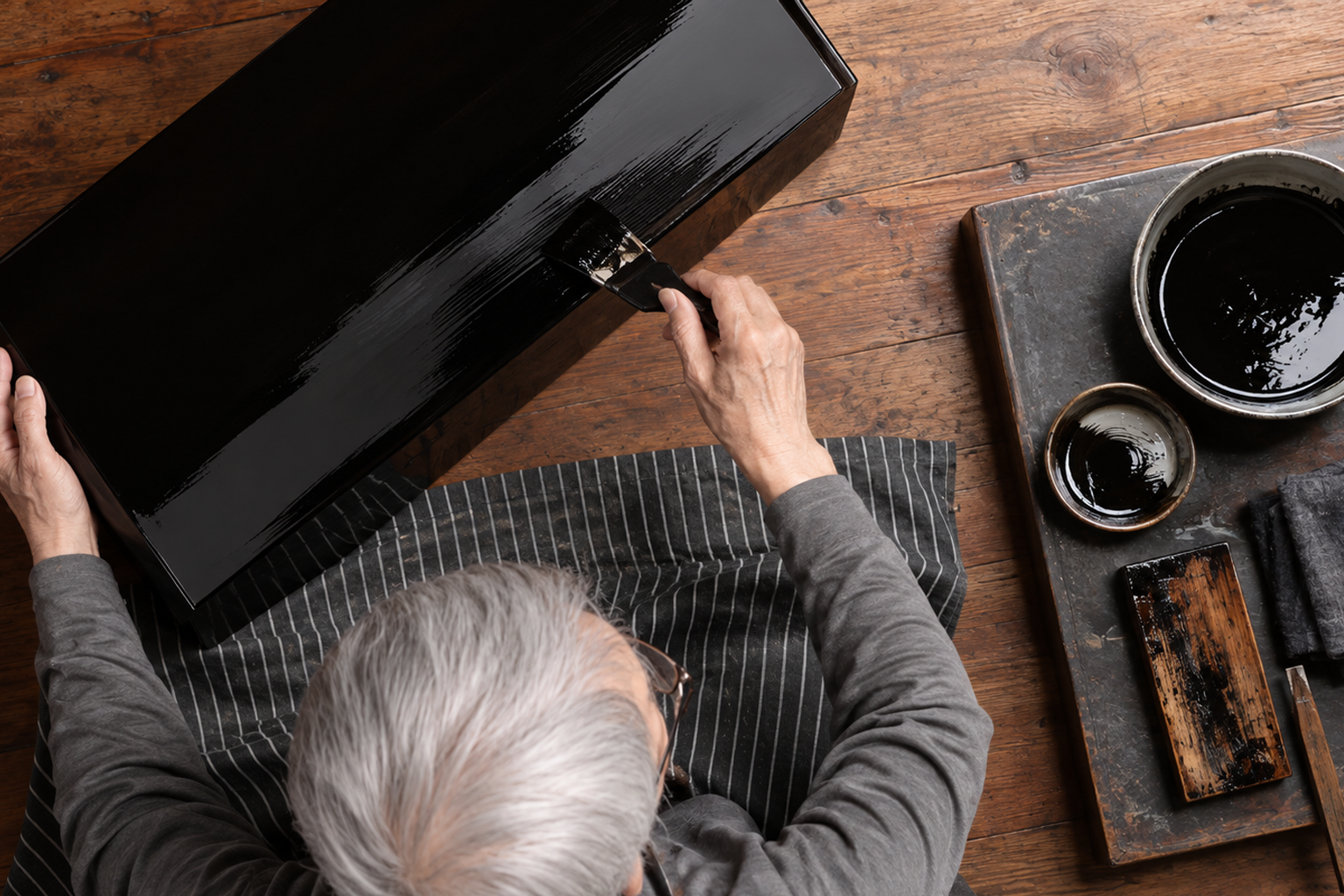
Gaps and irregularities are corrected and the surface is repeatedly filled, reinforced, coated, and leveled to create a stable ground for lacquer and inlay.
The composition is set, then shell is selected for color, grain, thickness, and iridescence. Each piece or strip is cut and shaped for the intended motif and technique.
The design is transferred to the prepared surface and the shell is positioned and fixed by hand. Precision here determines the clarity and rhythm of the final pattern.
Lacquer is applied in controlled layers and given time to cure before the surface is worked again. Coating, curing, and leveling may repeat as shell and lacquer are brought into one plane.
The surface is carefully abraded to reveal the inlay and refine its level. Final polishing brings out the depth of the lacquer and the changing light of the mother-of-pearl.
Beyond the Steps
In Najeonchilgi, time is not simply the length of production. Some stages cannot be rushed.
Natural lacquer needs suitable temperature and humidity to cure, and each later layer depends on the stability of the one beneath it. The artisan must often wait before the surface can be coated, refined, or polished again.
As coating, curing, grinding, leveling, and polishing repeat, much of the making time becomes invisible in the finished object. Dense inlay, complex forms, larger scale, and a higher finishing standard can extend that work considerably.
Production time therefore varies widely. Depending on the object, method, and level of finish, making may extend from weeks to months or longer.
Time is not separate from the object. It is built into the surface.
Korean Najeon
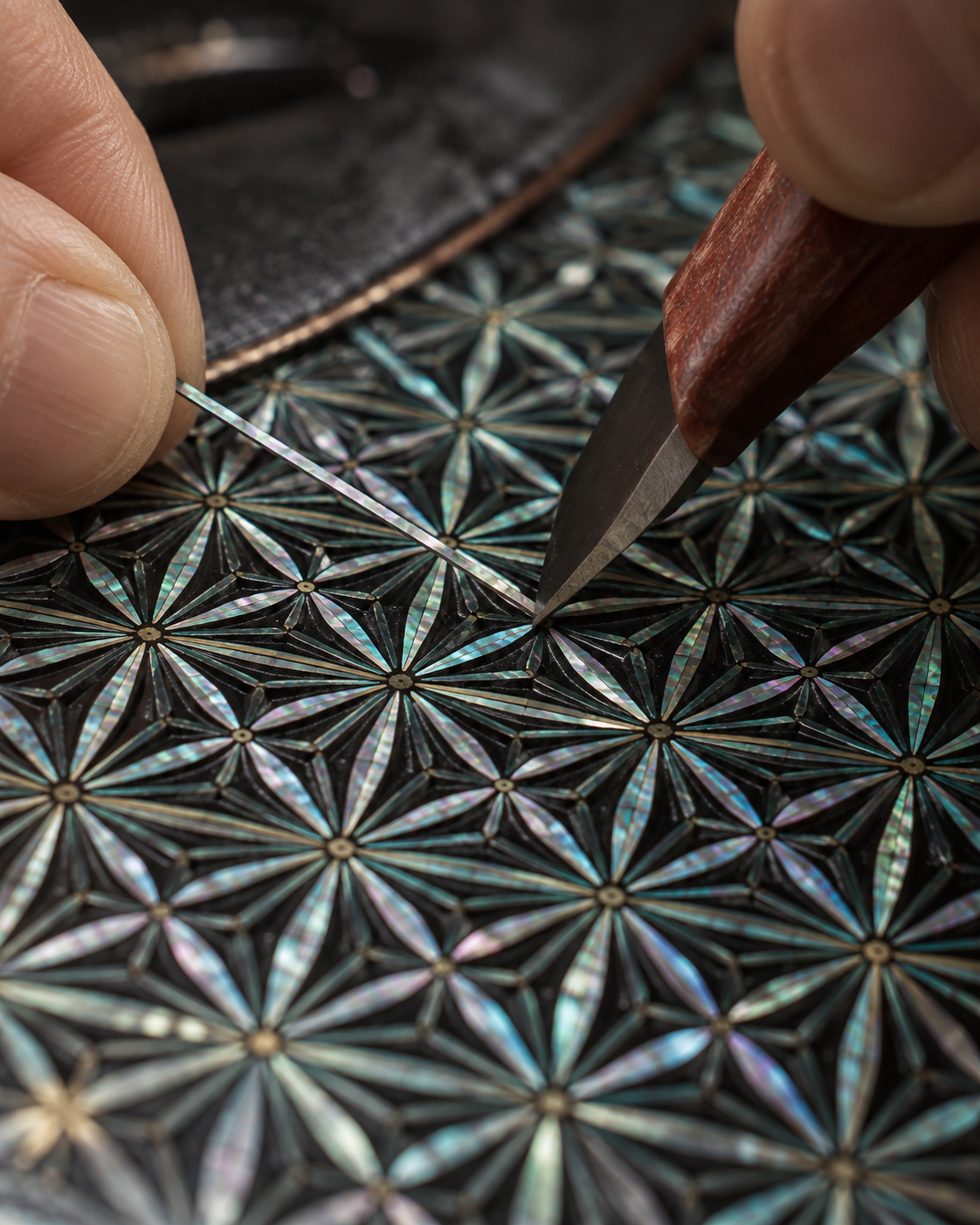
Korean Najeonchilgi is not defined by brilliance alone. Its character comes from how shell is selected, cut, arranged, and integrated with lacquer — and from the precision with which many small elements become a single composition.
Mother-of-pearl is cut and shaped to follow a motif or contour, allowing larger curved and pictorial elements to be assembled on the surface.
Thin strips of shell are broken or cut into short units and placed repeatedly, making it possible to construct lines, geometry, and dense pattern through accumulation.
A Different Challenge Today
Najeonchilgi is not a lost craft. Korean artisans continue to work, techniques continue to be transmitted, and important new works are still being made. But the survival of a technique is not the same as the survival of the conditions that once gave that technique a natural place in everyday life.
Traditional chests, boxes, cabinets, and household objects belonged to particular ways of living. Housing, furniture, storage, interior scale, purchasing habits, and the speed of production have changed. A craft based on long handwork, repeated lacquer, curing, and refinement now exists inside a market largely shaped by standardized industrial goods.
Large chests and traditional storage furniture no longer occupy the same role in many contemporary homes. The spaces, dimensions, and functions that once sustained the craft have narrowed or changed.
Industrial production normalized speed, consistency, wide distribution, and direct price comparison. Work that depends on long manual processes cannot be understood fairly by those measures alone.
When maker, workshop, place, material, technique, year, and process are not carried with an object, much of what distinguishes skilled craft from an anonymous decorative product becomes difficult to see.
KNNN Observation
KNNN does not see Najeonchilgi as a tradition that needs to be replaced. The material, techniques, makers, and history already contain value. What is often missing is a continuous structure that researches that value, records it, translates it into contemporary use, explains it clearly, and carries it forward with the object.
Study materials, techniques, motifs, historical works, regional context, and the people who keep the craft alive before deciding what should be changed or preserved.
Build a consistent record around each object so its identity, making, and provenance can remain traceable over time.
Develop proportions, functions, and forms that can belong naturally in contemporary spaces without erasing the material logic that makes the craft distinct.
Work with artisans and production partners to turn research and design into real objects, with the process itself becoming part of what is preserved and recorded.
Explain an object through its people, materials, skill, time, origin, and purpose — not only through the visual shorthand of “Korean traditional design.”
Connect the craft with new owners, collectors, homes, institutions, hospitality projects, cultural programs, and markets where it can gain another reason to be used.
KNNN is not trying to invent a new tradition. We are trying to reconnect value, record, use, and continuity around what already deserves to remain.
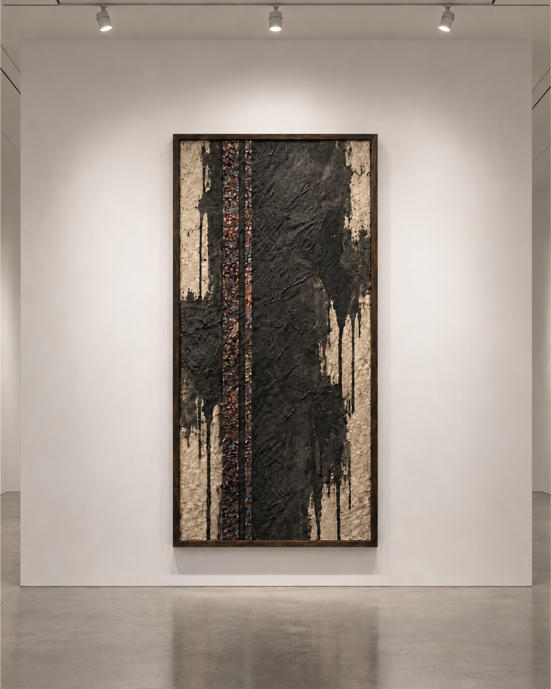
Contemporary Use
Tradition does not have to abandon its identity in order to gain new uses. If the material logic and skilled processes of Najeonchilgi remain intact, new dimensions, functions, and settings can create additional reasons for artisans to keep using those techniques.
KNNN Perspective
KNNN’s long-term goal is not only to make objects. It is to keep enough information with them that their origin and making remain legible after the moment of sale.
A well-made object can last for decades, but its identity can disappear much sooner. Once the maker, workshop, date, material, technique, and production story are separated from the work, a precisely made piece can eventually become only “an old mother-of-pearl object.”
KNNN wants the record to remain with the piece: who made it, where it was made, what it was made from, how it was made, when it was completed, and why it was created. When those individual records accumulate, they can become something larger — an archive connecting makers, materials, techniques, regions, objects, and time.
Preserve the knowledge. Create the next use. Let the record remain with what is made.
Custom Commissions
KNNN accepts commissions for custom Najeonchilgi furniture and objects developed in collaboration with Korean artisans and makers.
Each project is planned according to purpose, scale, material, technique, and design. Where practical, each completed commission is accompanied by a project record documenting its maker, production place, materials, techniques, completion date, and relevant making history.
Enquire About a Commission